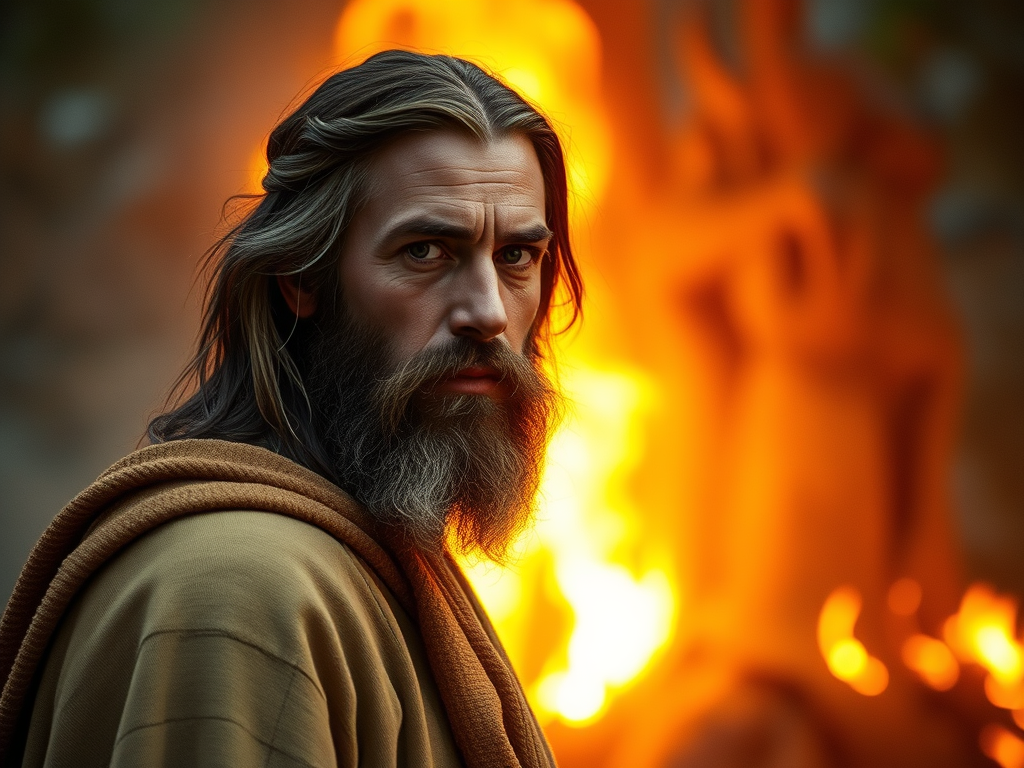
AI generated image
Background
23 During that long period, the king of Egypt died. The Israelites groaned in their slavery and cried out, and their cry for help because of their slavery went up to God. 24 God heard their groaning and he remembered his covenant with Abraham, with Isaac and with Jacob. 25 So God looked on the Israelites and was concerned about them.
3 Now Moses was tending the flock of Jethro his father-in-law, the priest of Midian, and he led the flock to the far side of the wilderness and came to Horeb, the mountain of God. 2 There the angel of the Lord appeared to him in flames of fire from within a bush. Moses saw that though the bush was on fire it did not burn up. 3 So Moses thought, “I will go over and see this strange sight—why the bush does not burn up.”
4 When the Lord saw that he had gone over to look, God called to him from within the bush, “Moses! Moses!”
And Moses said, “Here I am.”
5 “Do not come any closer,” God said. “Take off your sandals, for the place where you are standing is holy ground.” 6 Then he said, “I am the God of your father, the God of Abraham, the God of Isaac and the God of Jacob.” At this, Moses hid his face, because he was afraid to look at God.
7 The Lord said, “I have indeed seen the misery of my people in Egypt. I have heard them crying out because of their slave drivers, and I am concerned about their suffering. 8 So I have come down to rescue them from the hand of the Egyptians and to bring them up out of that land into a good and spacious land, a land flowing with milk and honey—the home of the Canaanites, Hittites, Amorites, Perizzites, Hivites and Jebusites. 9 And now the cry of the Israelites has reached me, and I have seen the way the Egyptians are oppressing them. 10 So now, go. I am sending you to Pharaoh to bring my people the Israelites out of Egypt.”
Exodus 2:23 – 3:10
Background
Chapter two of Exodus began with a miracle. And ends with an exile.
First, an order – “Every Hebrew boy who is born must be thrown into the Nile”. A defiant and protective mom. An obedient and protective sister. And a baby picked out of the water from a papyrus basket. From a princess, nevertheless. An intervening miracle.
It is hard to really imagine and absorb the heaviness of the first few months of Moses’ life. An oppressive edict. Male babies killed. Mothers and fathers – broken spirits. Anguish. Nothing was assured. Hopelessness. And even the thoughtful planning of the basket voyage must have been viewed as a desperate long-shot. Baby Moses must have felt the fear…even as he was being held.
And for years the miracle continued. Until it seemed like it didn’t. In verse 6 of chapter 2, Moses was picked up and rescued by Pharaoh’s daughter. And in another 6 short verses we find that Moses was named. Raised. Grown. And found out (murdering an Egyptian oppressor). And in that last act his life shifted. Quickly.
Moses fled for his life. Fear. He fled out of Egypt to a place called Midian. A place of nomads. And shepherds. A vacation spot? Not so much. A place to hide? Perfect.
And for forty years Moses built a life in the desert. Solitude. Time alone. Off the grid.
It is a bit paradoxical. Being raised and trained in a palace – what did it get him? Character formation that results in vigilante justice. Death – Murder. Being prepared and trained in a desert – what did it get him? Qualifications for one of the most important assignments in scripture. Life – Redemption.
The desert. Why was this training spot critical for God to direct Moses?
The desert. Why was David, a man after God’s own heart, similarly forged in a desert?
For that matter, why were the first 40 days of Jesus ministry spent…again – in the desert?
Could it be possible that something special is often found in the desert?
Reflections
Recently I have learned about the desert fathers and mothers. Christians that left secular culture in the 4th and 5th centuries for the desert. To find God. Often for decades. And many would return to culture later in their life. Fully changed. Character reformed. Countenances almost shining. Living lighthouses.
They looked different. They thought different. And most importantly – many recognized, they were different.
While living in Hong Kong, I attended a church called The Vine. A few years ago, the pastor did a long series on Exodus. He traveled to the middle east with a film crew. To see. To chronicle the Exodus story. As part of his series, the pastor wanted to experience what it felt like to spend the night in the desert alone. His team dropped him off deep in an Israel desert with his cameras at sunset. Alone. No cell phone. No contact. His team agreed to pick him up at a certain coordinate in the morning. He videotaped himself at moments throughout the night. It was amusing (for me). But I give him credit. Throughout the clips you could see anxiousness evolve into fear. He was vigilant. He listened. No sleep that night. He listened.
And the night sounds at times seemed loud.
We live in a culture that shivers at the thought of silence. And solitude. Few practice it. Most run from it. I’m convinced some are afraid of it. We describe our “busy” weekends…with a half-smile. Almost proud. Long workdays. Kid’s after-school activities. Demanding hobbies. Even our quiet times frequently include a form of white noise. Scrolling. Social media. News and sports updates. Spotify. Even the church demands can be unrelenting.
But, could it be possible that a life designed to resist the noise and to embrace silence and solitude – could once again transform our character? And maybe – transform culture?
Henri Nouwen, writer of The Way of the Heart – The Spirituality of the Desert Fathers and Mothers suggests that “Solitude is the furnace of transformation”.
Lord, please help me to continue to chase You into my own version of the desert. Help me to chase solitude. Silence. Whisper to me. Let me come to embrace what is so uncomfortable to me.
Beyond all else, transform my heart. Give me a greater vision and understanding of ways I can increasingly incorporate solitude into my daily rhythms.
Help Christians in our culture to both identify and reject the busyness. The alternatives. The noise. And to embrace Silence. And Solitude. And let them find life. In the furnace of solitude.
Amen.
What if in our pursuit of solitude and silence, our character was fully transformed? How could that transformation impact the effectiveness of our testimony? Our marriages? Our family legacies?
What if Christians began to embrace and practice a counter-cultural rhythm of silence and solitude? How would that impact our culture?

 What if...
Thanks Ron, for another good devotional that helps me (and others) enrich our spiritual lives.
LikeLiked by 1 person