
Corinth letter – A radical theology

Picture is AI generated

But we have this treasure in jars of clay to show that this all-surpassing power is from God and not from us. We are hard pressed on every side, but not crushed; perplexed, but not in despair; persecuted, but not abandoned; struck down, but not destroyed. 10 We always carry around in our body the death of Jesus, so that the life of Jesus may also be revealed in our body. 11 For we who are alive are always being given over to death for Jesus’ sake, so that his life may also be revealed in our mortal body. 12 So then, death is at work in us, but life is at work in you.

13 It is written: “I believed; therefore I have spoken.”[b] Since we have that same spirit of[c] faith, we also believe and therefore speak, 14 because we know that the one who raised the Lord Jesus from the dead will also raise us with Jesus and present us with you to himself. 15 All this is for your benefit, so that the grace that is reaching more and more people may cause thanksgiving to overflow to the glory of God.

16 Therefore we do not lose heart. Though outwardly we are wasting away, yet inwardly we are being renewed day by day. 17 For our light and momentary troubles are achieving for us an eternal glory that far outweighs them all. 18 So we fix our eyes not on what is seen, but on what is unseen, since what is seen is temporary, but what is unseen is eternal.

2 Corinthians 4:7-18

But he said to me, “My grace is sufficient for you, for my power is made perfect in weakness.” Therefore I will boast all the more gladly about my weaknesses, so that Christ’s power may rest on me. 10 That is why, for Christ’s sake, I delight in weaknesses, in insults, in hardships, in persecutions, in difficulties. For when I am weak, then I am strong.

2 Corinthians 12:9-10

Background

Paul founded the Corinth church.  He loved this church.  But what had started as good.  Had been attacked.  Infiltrated by opponents.  Detractors.

Not surprising.  The good.  Is always attacked.

He had returned to the Corinth church in the years before this letter was sent.  And the reception was heartbreaking.  Rejection.  Likely humiliation.  Many would have cut their losses – moved on.  Found a group that welcomed him.  Valued him.  Even liked him.  Distanced themselves from the rejection. 

Not Paul.  Nope.  Paul was different.

This letter had multiple objectives.  One was to reject a central argument introduced by the antagonists – “Paul suffered too much to be a Spirit-filled apostle of the risen Christ” (ESV Commentary). Versions of the prosperity gospel starting early.  The argument being an apostle should be immune from the really hard stuff.  And the spirit of this argument had gained traction.  And it appealed to the imaginations.  Especially imaginations that wanted to believe that this gospel made life easier on this side of heaven.

Paul didn’t qualify for this type of gospel theology.  He suffered.  A lot.  Prisons.  Beatings.  Thirty-nine lashes – Five times.  Beaten with rods – Three times.  Stoned – Once.  Shipwrecked – Once.  And that wasn’t all of it.  Word had gotten around. 

Paul’s testimony couldn’t have been more at odds with the attractive gospel vision being shared by the others.

This authentic letter was intended to frame a different vision.  And that vision started with a reminder – We are clay jars.  And within that construct there is weakness.  We are “hard pressed on every side”; “perplexed”; “persecuted” and “struck down”. 

A Christian life often marked by difficulty.  

But.  Those verbs weren’t the whole story.  Each were connected to a critical reminder. The second half of the clause.  “pressed on every side not crushed”; “perplexed – not in despair”; “persecuted – not abandoned”; “struck down – not destroyed”.  

In this life – we have to remember the other side.

The critical insight is emphasized in chapter 12:9-10…God’s power “is made perfect in weakness”.  And in that belief, Paul had come to embrace a much different type of theology than the one introduced by the Corinthian detractors.  Paul so much believed this truth that he actually delighted in weaknesses.  Insults.  Hardships.  Persecutions.  Difficulties.   

Because, strength can be revealed and even forged in weakness.

Reflections

This theology is hard.

Paul’s truth is essential to guide centered perspectives.  To move beyond a thinking that yearns for outcomes on this side that are exclusively easy.  Comfortable.  Happy.  Connected.

But instead to recognize that His power is made perfect in my weakness.  And that in hardship, or difficulty.  We are made strong.  

These last few years have been one of those seasons.  A hard season.  A season that was brought on by me.  Bad decisions.  Mistakes.  Regrets.  I journal almost every day.  Electronically.  And this software package allows me to view my thoughts.  And prayers.  From the exact day one year ago.  Two years ago.  Up to 6 years ago.  I am frequently interested in what was on my mind in years past.  On that same day.  And I have found a consistent theme.   Prayer after prayer.  Day after day.  Praying for the same things.  That all would be healed.  Restored.  Made better.  Fixed.  Made comfortable.  Easier.  Happier.

I have yet to find a prayer – “Lord, today…please amplify my weakness.  My limitations.  Even my discomfort and pain…so that you can be lifted up today.  Use my weaknesses or failings to make you look stronger”.

Theology matters.  How we live God-centered theology matters even more.

Ok.  That’s enough.  Let’s do this.  That streak is going to end.  Today.

Let’s pray.

Lord, thank you for my hard season.  For the crushing.  For the pressing in.  Yes.  Even for the loneliness. 

Today.  Tonight.  Please consider making me even weaker.  Even more uncomfortable.  Through a hardship.  But don’t let the story stop there.  Create the other side.  Use my weakness in some way to lift You up.  Do whatever you need or can to let my story and circumstances cast incremental glory to You. Perhaps even to make me stronger.

Help my theology.  My prayers.  To not conveniently yield to attractive theories that seem so appealing.  Comfortable.  But instead to increasingly get excited about being open to a form of incremental weakness.  Difficulty.  Hardship.  Just like Paul.

I trust You.  In the hardship.  That I won’t be crushed.  I won’t be in despair.  I won’t be abandoned.  And I won’t be destroyed.

Let’s do this. 

To You be the glory.

Amen.    

What if we lived this theology to the extent that Paul did?  How would our conversations change about our difficult hardships?  How would our prayers change?

What if peace and joy began to increasingly emerge as we adopted different thinking?
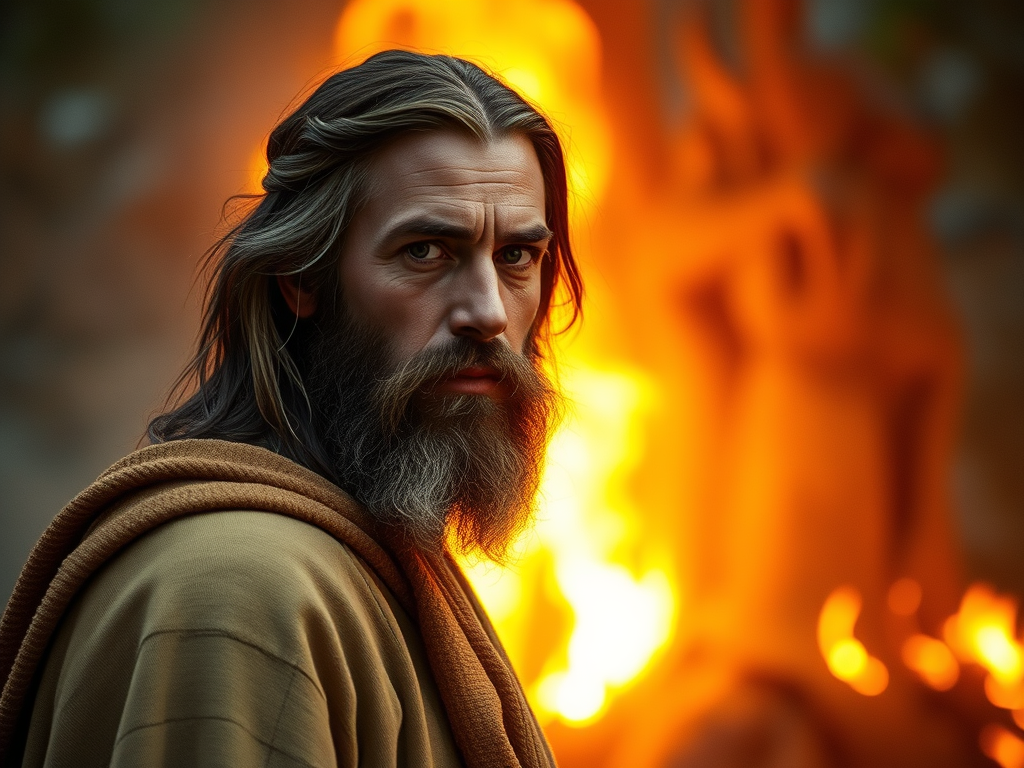
Transformation – In the desert…

AI generated image

Background

23 During that long period, the king of Egypt died. The Israelites groaned in their slavery and cried out, and their cry for help because of their slavery went up to God. 24 God heard their groaning and he remembered his covenant with Abraham, with Isaac and with Jacob. 25 So God looked on the Israelites and was concerned about them.

Now Moses was tending the flock of Jethro his father-in-law, the priest of Midian, and he led the flock to the far side of the wilderness and came to Horeb, the mountain of God. There the angel of the Lord appeared to him in flames of fire from within a bush. Moses saw that though the bush was on fire it did not burn up. So Moses thought, “I will go over and see this strange sight—why the bush does not burn up.”

When the Lord saw that he had gone over to look, God called to him from within the bush, “Moses! Moses!”

And Moses said, “Here I am.”

“Do not come any closer,” God said. “Take off your sandals, for the place where you are standing is holy ground.” Then he said, “I am the God of your father, the God of Abraham, the God of Isaac and the God of Jacob.” At this, Moses hid his face, because he was afraid to look at God.

The Lord said, “I have indeed seen the misery of my people in Egypt. I have heard them crying out because of their slave drivers, and I am concerned about their suffering. So I have come down to rescue them from the hand of the Egyptians and to bring them up out of that land into a good and spacious land, a land flowing with milk and honey—the home of the Canaanites, Hittites, Amorites, Perizzites, Hivites and Jebusites. And now the cry of the Israelites has reached me, and I have seen the way the Egyptians are oppressing them. 10 So now, go. I am sending you to Pharaoh to bring my people the Israelites out of Egypt.”

Exodus 2:23 – 3:10

Background

Chapter two of Exodus began with a miracle.  And ends with an exile. 

First, an order – “Every Hebrew boy who is born must be thrown into the Nile”.  A defiant and protective mom.  An obedient and protective sister.   And a baby picked out of the water from a papyrus basket.  From a princess, nevertheless.   An intervening miracle.

It is hard to really imagine and absorb the heaviness of the first few months of Moses’ life.  An oppressive edict.  Male babies killed.  Mothers and fathers – broken spirits.  Anguish.  Nothing was assured.  Hopelessness. And even the thoughtful planning of the basket voyage must have been viewed as a desperate long-shot.  Baby Moses must have felt the fear…even as he was being held.

And for years the miracle continued. Until it seemed like it didn’t. In verse 6 of chapter 2, Moses was picked up and rescued by Pharaoh’s daughter. And in another 6 short verses we find that Moses was named. Raised. Grown. And found out (murdering an Egyptian oppressor). And in that last act his life shifted. Quickly.

Moses fled for his life. Fear. He fled out of Egypt to a place called Midian. A place of nomads. And shepherds. A vacation spot? Not so much. A place to hide? Perfect.

And for forty years Moses built a life in the desert. Solitude. Time alone. Off the grid.

It is a bit paradoxical. Being raised and trained in a palace – what did it get him? Character formation that results in vigilante justice. Death – Murder. Being prepared and trained in a desert – what did it get him? Qualifications for one of the most important assignments in scripture. Life – Redemption.

The desert. Why was this training spot critical for God to direct Moses?

The desert. Why was David, a man after God’s own heart, similarly forged in a desert?

For that matter, why were the first 40 days of Jesus ministry spent…again – in the desert?

Could it be possible that something special is often found in the desert?

Reflections

Recently I have learned about the desert fathers and mothers. Christians that left secular culture in the 4th and 5th centuries for the desert. To find God. Often for decades. And many would return to culture later in their life. Fully changed. Character reformed. Countenances almost shining. Living lighthouses.

They looked different. They thought different. And most importantly – many recognized, they were different.

While living in Hong Kong, I attended a church called The Vine. A few years ago, the pastor did a long series on Exodus. He traveled to the middle east with a film crew. To see. To chronicle the Exodus story. As part of his series, the pastor wanted to experience what it felt like to spend the night in the desert alone. His team dropped him off deep in an Israel desert with his cameras at sunset. Alone. No cell phone. No contact. His team agreed to pick him up at a certain coordinate in the morning. He videotaped himself at moments throughout the night. It was amusing (for me). But I give him credit. Throughout the clips you could see anxiousness evolve into fear. He was vigilant. He listened. No sleep that night. He listened.

And the night sounds at times seemed loud.

We live in a culture that shivers at the thought of silence. And solitude. Few practice it. Most run from it. I’m convinced some are afraid of it. We describe our “busy” weekends…with a half-smile. Almost proud. Long workdays. Kid’s after-school activities. Demanding hobbies. Even our quiet times frequently include a form of white noise. Scrolling. Social media. News and sports updates. Spotify. Even the church demands can be unrelenting.

But, could it be possible that a life designed to resist the noise and to embrace silence and solitude – could once again transform our character? And maybe – transform culture?

Henri Nouwen, writer of The Way of the Heart – The Spirituality of the Desert Fathers and Mothers suggests that “Solitude is the furnace of transformation”.

Lord, please help me to continue to chase You into my own version of the desert. Help me to chase solitude. Silence. Whisper to me. Let me come to embrace what is so uncomfortable to me.

Beyond all else, transform my heart. Give me a greater vision and understanding of ways I can increasingly incorporate solitude into my daily rhythms.

Help Christians in our culture to both identify and reject the busyness. The alternatives. The noise. And to embrace Silence. And Solitude. And let them find life. In the furnace of solitude.

Amen.

What if in our pursuit of solitude and silence, our character was fully transformed? How could that transformation impact the effectiveness of our testimony? Our marriages? Our family legacies?

What if Christians began to embrace and practice a counter-cultural rhythm of silence and solitude? How would that impact our culture?

An Unwilling Messenger

Then the word of the Lord came to Jonah a second time: “Go to the great city of Nineveh and proclaim to it the message I give you.”

Jonah obeyed the word of the Lord and went to Nineveh. Now Nineveh was a very large city; it took three days to go through it. Jonah began by going a day’s journey into the city, proclaiming, “Forty more days and Nineveh will be overthrown.” The Ninevites believed God. A fast was proclaimed, and all of them, from the greatest to the least, put on sackcloth.

When Jonah’s warning reached the king of Nineveh, he rose from his throne, took off his royal robes, covered himself with sackcloth and sat down in the dust. This is the proclamation he issued in Nineveh:

“By the decree of the king and his nobles:

Do not let people or animals, herds or flocks, taste anything; do not let them eat or drink. But let people and animals be covered with sackcloth. Let everyone call urgently on God. Let them give up their evil ways and their violence. Who knows? God may yet relent and with compassion turn from his fierce anger so that we will not perish.”

10 When God saw what they did and how they turned from their evil ways, he relented and did not bring on them the destruction he had threatened.

Jonah 3:1-1-0

Background

Nineveh was a major commercial and cultural hub.  It was located on the Tigris.  And populated primarily by Assyrians.  The city was astray.  Rebellious and sinful living.  Judgment had been earned.

God had weighed it all.  Seen it all.  He measured the heart of the city.  And all was not good.  It was time. 

For a last chance. 

A messenger was needed.  And in heaven’s design center – where each life and story is carefully crafted.  And where special purposes. And assignments are wonderfully designed.  Another unlikely character was chosen – Jonah.  Stubborn.  Hard-headed.  Brazen.  The delivery of this message was Jonah’s assignment.  

Yes, another scriptural story assignment where the roles were…well…a head scratcher.

He was neither an Assyrian (living over 500 miles away)…nor was he willing to extend grace.  Jonah had seen enough.  The story does little to form the reasons for his resentment.  But his emotions and pov’s were strong.  The fact patterns that formed his view were cemented. And he wanted no part of a compassionate script.  In Jonah’s mind Nineveh had earned only one option.  It wasn’t empathy.  It was judgment. 

So.  One of scripture’s most surprising stories emerged.  A last chance of grace was to be delivered by a tourist.  A very unwilling messenger.  A messenger summoned. A messenger that fled.

Quite the strategy.

This message I suspect was ultimately delivered with fierceness.  Heavy on judgment.  Sins.  Infractions.  Directness. Light on warmth.  Empathy. Tact. 

I have so often wondered – “Why on earth was Jonah selected?

I prefer my biblical protagonists to be likeable.  Jonah? Not so much. 

In reflection, I wonder if it is possible that God simply selected the messenger best aligned with carrying out His mission.  This was a hard assignment.  The Ninevites were hard people. Their attention was mesmerized by idols. This assignment required a strong personality.  To call out the infractions.  The waywardness.  The necessity of repentance.  Straight talk.  With an edge.  Nineveh needed a fierce and fiery delivery.  No punches held back.

Enter Jonah.

Reflections

It is easy to shake our heads when reading Jonah.  Becoming even amused at this seemingly misplaced rebellious bible character. 

I frequently think and dream about my purpose.  What is my assignment?  What if I just miss it?  What if I don’t figure it out?  What if I’m not good enough?  Almost like a real-life escape room.  I have to connect the dots.  Solve the problems.  Pay close attention to the clues.  Yes.  You might recognize that my theology frequently assigns a belief that my performance is the key to unlock the mystery.

Hmmm…

The story of Jonah couldn’t be more different.   In the celestial design center, a purpose was assigned to Jonah’s life mission.  An important role.  In this case there wasn’t a Plan B.  There was only one messenger planned.  God pursued Jonah.  With tenacity.  

Beyond the entertainment value, what does Jonah’s story tell me?

One, God uses enormously flawed and imperfect people.  Like me.  That gives me hope.

Two, nothing will avert or deny God’s plan.  He is relentless in the pursuit of his authored story lines.  That reminds me of His power.  No obstacle or resistance has a chance.

Three, God offers grace to those that we believe have earned judgment.  That reminds me to similarly offer grace.  Even to those I believe I have earned another “prize”.

Lastly, God is relentless in guiding us towards our purposeful assignments.  And that reminds me to loosen up.  Worry less.  Surrender. And trust that He is a good father who will guide me towards my assignment.   In His timing.

Lord, too frequently when I have read the Jonah story I have proudly wondered why he was such a knucklehead.  But.  You know.  I am all too similar.  I’m sorry.  Use me.  Please.  Including my imperfections.  My failings.  Help me to live a life that seeks to extend your grace.  For so many years I have assigned judgment.  Remembered the hurts.  The words.  Continue to transform my heart.  Please.

Also, draw my heart to the Ninevites in our world.  And to offer your grace.

Lastly, help me to surrender.  To shake off this performance focused thinking.  That too often has guided my approach to relationships.  Even my theology.  I surrender my purpose to you.  In your timing.

Amen.

What if God’s sovereign plan for you (or me) was to similarly extend grace or a message of redemption to a wayward community?  What and where might that community be?

What if I began to live a life of surrender, believing that God’s plan for me will not be thwarted?  Is it possible that peace and joy could be more easily experienced?